
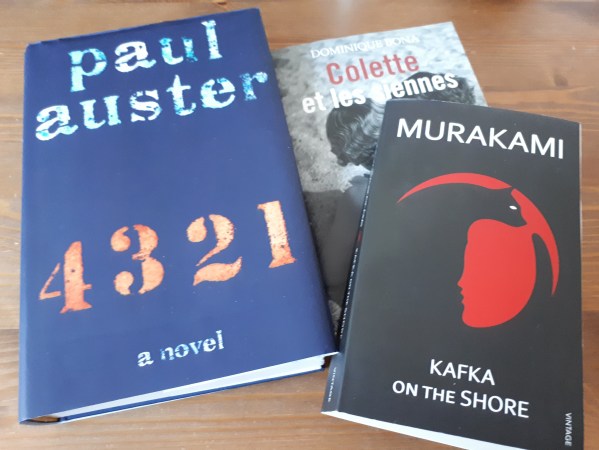
In six days, I was supposed to be standing on Champs-Élysées, waiting for the gun shot to go off at the start of one of the most spectacular races in the world. Unfortunately, on the result list – at my name – it will say DNS (Did Not Start). I am a runner, but right now an injured one. It’s not just not being able to run the race; it’s about not being able to run as usual, to get my daily adrenalin. Yes, I am addicted. Fortunately, I have my books and during my absence from running, I have been reading Paul Auster’s latest novel: 4 3 2 1.

Curro ergo sum – I run, therefore I am. The “accident” happened at the end of January (the first time). I blame the snow. It was my own fault; I was clumsy but at the same time unlucky. Ironically, it was on my way home from the gym so I wasn’t even running. I took my usual short cut but it was slippery and I fell. My right leg hurt; I felt a slight crash near the muscular attachment of my hamstring. The day after, I could hardly walk. After a few days rest, I started my rehab. My dream of running the Paris Marathon made me try – maybe a little too much – to come back in shape. I’ve run this beautiful race twice before (in 2004 and in 2012) but this time, I really wanted to do personal best and to run in my most beloved city.
I went to the gym and trained on the ellipse trainer and everything went quite well. But then, a Sunday at the beginning of March, I went to run with the training group for Stockholm Marathon – TSM (Team Stockholm Marathon). The half-marathon group was going to run sixteen kilometers so I joined the 5:40 pace group. This was right after the city was overtaken by more snow and everyone was caught by surprise. During the first 11-12 kilometers, running went fine. The walking path was full of snow and ice but it was clean on the cycling path. When we reached the city center, we had to run on the pavement and it was so slippery and muddy – two steps forward, one step back. It was stupid of me to continue but I ignored the pain since I was determined to run at least 16k. Afterwards, I could barely move, my hamstring hurt. I realized that I had done something stupid again.

The winter has been very long and cold this year and at the same time as my hamstring problems began, I got shoulder and neck pain – probably due to too much static work in front of the computer at work, together with the cold that has probably made me tighten my shoulders. However, I was sure that it would be better soon – I was training hard at the gym – how could a person like me get “office shoulders”???
But it was far more serious that I had first anticipated. Maybe I got in a bad habit of tightening my shoulders, maybe I just couldn’t relax in front of the computer. So, I ended up being on sick leave for two weeks – and for those two weeks, I couldn’t do the things I love the most: reading (my shoulders hurt so much that I couldn’t hold a book), writing (totally out of the question, the pain was most severe in my right shoulder and I am right handed) and running (due to my hamstring). However, sometimes it can be a good thing to do nothing (which is very unusual for me so I learned something new). I refused to give up and be depressed. And with perspective, my injuries were not serious.
By the middle of March, I found a way to sit in the sofa with a pillow under my book so I could read it without holding it in order to relax my shoulders and my neck. I had started reading Paul Auster’s 4 3 2 1 in January and had read about half the book – a thick book of more than 800 pages. My version is the hard pack copy so it’s quite heavy.
There are many characters, well, actually not that many but they are described in four stories in four different ways. In order to keep them apart and not mix them up together, I made notes about what happened in each chapter so when I returned to the first version in the next chapter, I knew which version it was. When I was halfway through the book, it occurred to me that there were actually more than one way to read this book. The book’s chapters are 1.1, 1.2, 1.3, 1.4 and then in chapter two it starts over again (2.1, 2.2, etc). So one could read all the chapters 1 first (1.1, 2.1, 3.1 etc), then you wouldn’t mix up the different versions of the same characters. However, I realized how I enjoyed reading the four different versions alternately of Ferguson, the main character. I wasn’t so hard to keep them apart since Auster always managed to get you back on track.
Most of the time I really enjoyed the book and found myself completely immersed in the stories. I felt that I got close to the characters. The only parts that were a little too heavy and long for me was all the baseball talk. However, I know that in the US, this is a big sport and I understand that American readers probably can relate to this more than I could. But after those parts, a more easy part always came and I was absorbed again.
The setting takes place in the fifties and the sixties in New Jersey and in New York City. I was born in the seventies – in Denmark – but I was reminded of things from my own childhood and could easily relate to the lives of the different Fergusons. In one version, Ferguson watches Stan Laurel and Oliver Hardy * which I did as well as a child. I watched them together with my mother and when Auster describes how Stan and Oliver changed the life one of the Fergusons, I can recognize myself in many of his thoughts; how I laughed at them together with my mother. I remembered her laugh and how much fun we had and I was very grateful for being reminded of those moments. Thanks to YouTube I’ve been able to watch some of the films again and now as a grown up, I find them so brilliant, and I think I understand what Auster tries to tell us. Watching these two guys being so clumsy but never giving up and I can’t help laughing. Maybe you have to have grown up with this to understand it. Anyway, it’s quite interesting that Ferguson (and Auster himself, I guess) watches this in the fifties and I watched them in the seventies; they were recorded in the twenties and thirties so they are living on for a very long time and you can still watch them on YouTube.
(* Laurel & Hardy – In Swedish: ”Helan & Halvan”, in Danish: ”Gø & Gokke”)
The way Auster depicts New York City made me feel that I was really there. However, I’ve been to New York several times and I know many of the streets and the places, among others the area around 58th Street and Columbus Circle. So reading about all those places was like being there. And finally, part of the book takes place in my favorite city – Paris. I love Auster’s way of writing; I cannot explain why, it simply appeals to me and I just want to share the following citation from 4 3 2 1:
”Time moved in two directions because every step into the future carried a memory of the past, and even though Ferguson had not yet turned fifteen, he had accumulated enough memories to know that the world around him was continually being shaped by the world within him, just as everyone else’s experience of the world was shaped by his own memories, and while all people were bound together by the common space they shared, their journeys through time were all different, which meant that each person lived in a slightly different world from everyone else”. (p. 347, Henry Holt and Company, 2017).
The meaning of pain: well, I’ve had pain in my shoulders, my neck, my hamstring but in a few days, the word pain (pronounced [pɛ̃]) will have another meaning: bread.
Yes, I am going to Paris even though I cannot run the race. This time, I will watch and cheer on all on all the lucky runners!
Right now, I am reading Dominique Bona’s Colette et les siennes to catch up on my French but also because it gives me courage and inspiration!
After Paris, I will go directly to Japan. Then I will read Murakami’s Kafta on the Shore. So, next time, I’ll be back with reports from Paris and Tokyo.
 The Book Runner
Enjoy anyway, Anne. life is about finding the bright sides of life. Look forward to hearing about Japan, where I always wanted to go since i had a penpal there when i was about 14 🙂
GillaGillad av 1 person