
We don’t talk enough about our feet when we talk about running and exercising. Our feet are our base, they carry us through life. Until recently, I thought that I treated my feet wisely but listening to a Swedish podcast (Maratonpodden with Petra Månström), I realized that I could treat my feet even better. Petra interviewed a foot specialist named Anders Nordström (Pluspraktik); both are very popular on Instagram and among runners in Sweden.

Taking care of my feet has for many years been natural and necessary for me as a runner. I do my foot exercises regularly and give my feet massage when they are tired. But I was afraid to run without my customized shoe insoles, so I always had them, not only in my running shoes but also in my everyday shoes. Even at home, I always had slippers with a protecting sole; I simply didn’t set my feet free. Now, since May, I’ve gradually trained my feet to get rid of the insoles. Furthermore, I’ve been running barefoot on grass and in sand (very short distances) and at home I now always walk barefoot. My feet have simply gotten stronger.
My hope with this blog post is to make you more aware of your feet by sharing my experiences. It’s actually quite small measures that you need to take in order to get healthy and strong feet and prevent or get rid of pain. It’s a free life insurance for your body. Many injuries in the body are caused by weakness of the feet and it’s actually not that strange since today, we lock in our feet in too narrow shoes and we don’t exercise them as they deserve.
My background
Running to me is crucial for my physical and mental well-being. Therefore, I am always open-minded to new advice and if I can optimize something in my body and avoid injuries, I am willing to try new recommendations.
The front arches of my feet are collapsed. It’s very common and I think I’ve had this condition for the most of my life (hard skin under the forefoot indicates that). So, the customized shoe insoles that I got in 1998 were constructed to lift up my forefeet. I had a problem with Morton’s neuroma as well and that disappeared with the insoles. I’ve had quite a few injuries as a runner: Plantar Fasciit, hip problems and my hamstring problems that have been following me for the most of my running life. Furthermore, I have a scoliosis so I thought that the insoles were necessary for me.
In 2013, I got an injury that opened my eyes to how important it is to strengthen my feet. Long story short: I sprained my right ankle, got an X-ray, nothing broken so I started running again shortly after. During the fall, I ran Lidingöloppet (a 30k trail run in Sweden) and Frankfurt Marathon. A few weeks after the marathon, I got an indescribable pain in my right foot and for some days I could hardly walk. I went to see an orthopedist, got an MRI, the result was vague; a “suspected arthrosis in the middle foot joint and an inflammation under the forefoot”. The doctor said that I could never run long distances again; he said that I maltreated my body by running too much (I ran approximately 40k per week at that time). He was cold and rude from the start and he just sat there with his fat belly with no empathy at all (looking at his belly, I thought: ”who’s maltreating one’s body”). So, I went to another doctor to get a second opinion. This doctor said that my foot was perfectly normal for a woman my age. Since then, I’ve ran six marathons and several halfs and 10k’s. So, by the end of 2013, I started being nice to my feet. A physiotherapist gave me exercises. I did my work out and little by little, I started running again. Foot strengthening became a routine in my work out sessions. Some exercises, I did every day at home (I still do). But I kept my customized shoe insoles; I was too afraid of injuries coming back.
Two years ago, I became a Personal Trainer. Learning about how the muscles works, origin and insertion, has contributed to me understanding my own work out better. My PT-clients are invaluable and I am truly grateful for what I’ve learned the last couple of years. It’s amazing how different our bodies respond to different exercises; I am learning for life! So, when Anders showed a movie on Instagram where he explains the construction of the foot – he has a model of the foot and peals of each layer to show each muscle, bone, and sinew; then I got this aha-moment that I think was thanks to my PT knowledge. All the muscles under your foot are really amazing to see. Of course, you can train up your feet muscles as any other muscle. Anders said that when he started using his feet, he got aches but that was normal since you always get aches in a muscle that is not used to exercising.
I threw away my slippers and I started walking barefoot at home. I went to the park nearby and ran a few minutes barefoot on the grass – and honestly, my feet were happy; it was a relief to set them free! And yes, I got aches but I didn’t panic. I just continued walking barefoot at home and gradually I quit my insoles in my running shoes. After the last session with my insoles (June 18) I got pain because of them! The “bump” on the insole that lifted up my forefoot now felt too hard and uncomfortable.
How to be nice to your feet
People often say that they don’t have time to exercise. One thing is to work out for 30-60 minutes, getting sweaty and needing a shower; yes, that takes time (however, you prioritize). But some exercises don’t make you sweaty and you can do them anytime and some of them anywhere. And it doesn’t have to take extra time when you do it at the same time as something else. If you have time to lie on your couch watching Netflix, then you can do some exercises at the same time. Exercising is not only about getting sweaty and a high pulse; it’s also about having your muscles work correctly. It’s about how to make the brain connect to your muscles. These small brain-connecting-to-muscle exercises will help you avoid injuries and then you can go to the gym and lift heavy weights (correctly) or run without pain or just being stronger in your everyday life. Don’t underestimate the small exercises that might seem ridiculous.
If you have problems with your feet, you should contact a specialist, e.g. a physiotherapist – one, who’s specialized in feet – to get a diagnosis and individual advice and exercises. However, some exercises, I believe, are never wrong, even for prevention of injuries but also as rehab:
Toe raise: stand with your forefoot on a step (or a thick book) and raise your body up and down, one foot at the time, barefoot. Think of pressing your big toe down (connect your brain to your muscle). 1 x 15 per foot. You can do this while brushing your teeth = no extra time (since you do brush your teeth, right?). You can also do this while waiting for the buss. If there’s no step just raise your feet up and down from the ground; better than not doing it at all.
Spread and grip with your toes: spread as much as you can and hold for ten seconds, grip for ten seconds and continue alternating. This you can do on your couch while watching your favorite series on Netflix!
Crab walk: on a yoga mat, walk back and forth by gripping the mat with your toes. If you have shoulder problems (as I have), you can roll them at the same time. A perfect break if you work in front of a computer all day.
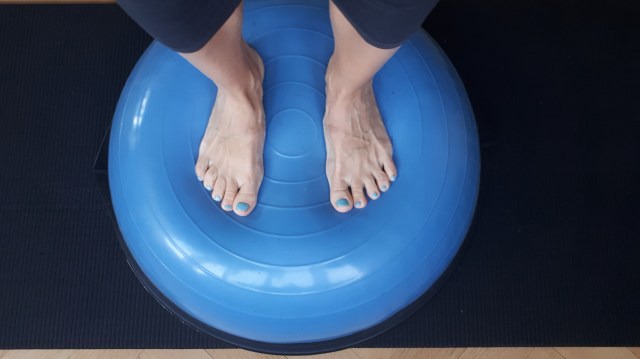
Balance: stand on one leg for one minute. When that is too easy, close your eyes. You can do this while brushing your teeth (toe raises in the morning and balance in the evening or vice versa).
The overall advice from Anders is to use your feet. I am an example that it works. However, please remember that this is no quick fix! I had been doing foot strengthening regularly for years before I dared quit my customized shoe insoles. I still have to keep working on my forefeet; the collapse is still there. Now when it’s getting colder outside, I have barefoot shoes in the park for foot strengthening, foot exercises and walking, and sometimes a few running steps. It’s important to gradually setting your feet free. Freedom demands responsibility. Be responsible for the well-being of your feet!
 The Book Runner
Väldigt tänkvärt och intressant.
Har själv funderat en hel del över det här med sko inlägg och hur det påverkar kroppen.
Så kul att höra att träning fungerar även på fötterna .
Bra skrivet ❣️🤗
GillaGillad av 1 person
Tack ❣
GillaGilla